According to the results of Global Matrix 3.0, a study conducted by the Active Healthy Kids Global Alliance (AHKGA), overall physical activity among children in Poland received a D- grade on the A-F five-grade scale. Such a low rank results from the fact that only 20% of kids in our country meet the WHO criteria regarding one-hour daily physical activity. Among 17 European countries, which took part in the survey, Poland, together with Germany, Denmark and Estonia, came second to last, followed only by Scotland, which received the worst grade in the index.
The Global Matrix 3.0 study compared 49 developed and developing countries from six continents. As many as 75% of them received a decent grade on physical activity among children as well as programmes encouraging the youngest generation to be active. All 517 experts involved in the study agreed that the problem of inactivity among children, which results from a sedentary lifestyle, was becoming more serious around the world. Compared to the Global Matrix 2.0 study results from 2016, the overall physical activity level among Polish kids has also deteriorated from D to D-.
– Global trends, including excessive screen time, are contributing to a generation of inactive children and putting them on a dangerous path – says Professor Mark Tremblay, President of the AHKGA and Senior Scientist at the CHEO Research Institute in Canada.
Negative effects of inactivity
The COSI 2016 study conducted by the Institute of Mother and Child under the auspices of the World Health Organisation indicates that in Poland more than 30% of eight-year-olds spend 2 hours in front of a TV or computer screen on a school day and 50% of eight-year-olds spend 3 hours in front of a TV or computer screen over weekends. In their comments to the Global Matrix 3.0 study published in the Journal of Physical Activity and Health experts alarm that the insufficient level of physical activity is currently the fourth leading factor behind mortality around the world. Why? Because inactive children get sick. Lack of physical activity increases the risk of type 2 diabetes, cardiovascular diseases and obesity in childhood. The COSI study showed that in Poland there are already 31.2% of eight-year-olds who are overweight and 12.7% of them suffer from obesity. One in ten second-graders has irregular blood pressure, which is connected with being overweight and obese. Lack of physical activity increases the risk of hypertension by 50% (International Journal of Cardiology).
Physical activity Polish-style
Apart from the overall physical activity level among children, experts working on the Global Matrix 3.0 study, including those from Poland, also had a look at other factors. One of them is a sedentary lifestyle which, according to the gathered material, was evaluated at the C- grade level. This means that in Poland as many as 80% of children and teenagers lead a sedentary lifestyle. Less than 20% participate in organised sport or physical classes (D) and only half of them use means of transport supporting physical activity, such as riding a bike (C).
School responsible for moving
Studies show that more than a half of Polish schools support physical activity among children and provide pupils with ca. 150 minutes of physical activity under the supervision of a PE teacher a week (B). Additionally, schools give children and whole families access to sports equipment outside of class. However, according to experts the level of physical activity in schools is still too low. Apart from grades which enable monitoring factors connected with physical activity among children, Global Matrix is a great source of inspiration from other countries. One of the examples is Slovenia which received highest grades in the following categories: overall physical activity (A-) or family and peers (B+), with the average B grade, meaning good. For almost 30 years sport has played an important role in the culture of Slovenia. Slovenes tend to view sport as an effective tool in fostering national identity among its citizens and throughout the world. Japan had the best grades for active transportation (A-). It has a highly established “walking to school practice” that has been implemented since the School Education Act enforcement order, enacted in 1953. It states that public elementary schools should be located within no more than 4 km, and for public junior high schools no more than 6 km from the student’s home.
Polish element during the Global Matrix 3.0 study presentation
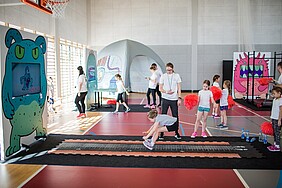
The Global Matrix 3.0 study results were presented during the international Movement to Move Conference in Australia. At the conference the organising committee awarded the Polish initiative supporting physical activity among children, Active MultiSport Schools. This programme inspires teachers, parents and children to come up with interesting solutions that support physical activity. As a part of the initiative, its organisers – V4Sport Foundation and Benefit Systems – have visited 35 schools in dolnośląskie province where they did a multimedia physical ability test based on 9 stations with simple sport exercises such as hanging on a bar, long jump or a hand squeeze trial. Undertaking sports challenges children have to face monsters from the Immobility Galaxy. Within the initiative organisers measure the physical activity level among children but also inspire pupils, teachers and parents to take an innovative look at physical activity. As the V4Sport Foundation that executes the project emphasises, every activity that makes children want to put on sports clothes and shoes is good. Within the initiative there are also training plans, which parents as well as school and local communities take part in, prepared. Their aim is to create solutions that foster everyday physical activity among children.
- We are very happy that our local initiative has been acknowledged by an international group of experts, that we play an active role in the global action to activate children and that we can realise a project that reactivates the habit to be active among the youngest generation in Poland. For us active young generations mean healthy and functional society in the future because, as the MultiSport Index 2018 study shows, one in three Poles still does not undertake any physical activity, even once a month. Among active Poles there is only 6% of parents who choose their children as partners in physical activity – says Adam Radzki, Management Board Member at Benefit Systems.
More information about the Active MultiSport Schools Programme can be found here: www.aktywneszkoly.pl. Complete information and full results of countries taking part in the study are available here: https://www.activehealthykids.org oraz na polskiej stronie http://activehealthykids.pl.
MEDIA CONTACT:
Agnieszka Bemowska 517 172 559 | a.bemowska@benefitsystems.pl
Active MultiSport Schools is a project whose aim is to physically activate school-age children and proper sports education. The Active MultiSport Schools sports programme consists of 9 physical exercises acknowledged in the EuroFit physical activity test presented as a story-based interactive game. So far the project has been executed in 35 schools in dolnośląskie province with the activity level measured among 9000 children. The organiser of the project is V4Sport Foundation while its originator and sponsor – Benefit Systems. More information about the project can be found here: www.aktywneszkoly.pl
